What to know
- Faster healing and tissue regeneration.
- Preservation of more of the natural tooth.
- Reduced bleeding during and after treatment.
- Reduced need for anesthesia.
- Reduced need for stitches and sutures.
- Reduced risk of bacterial infections after procedures.
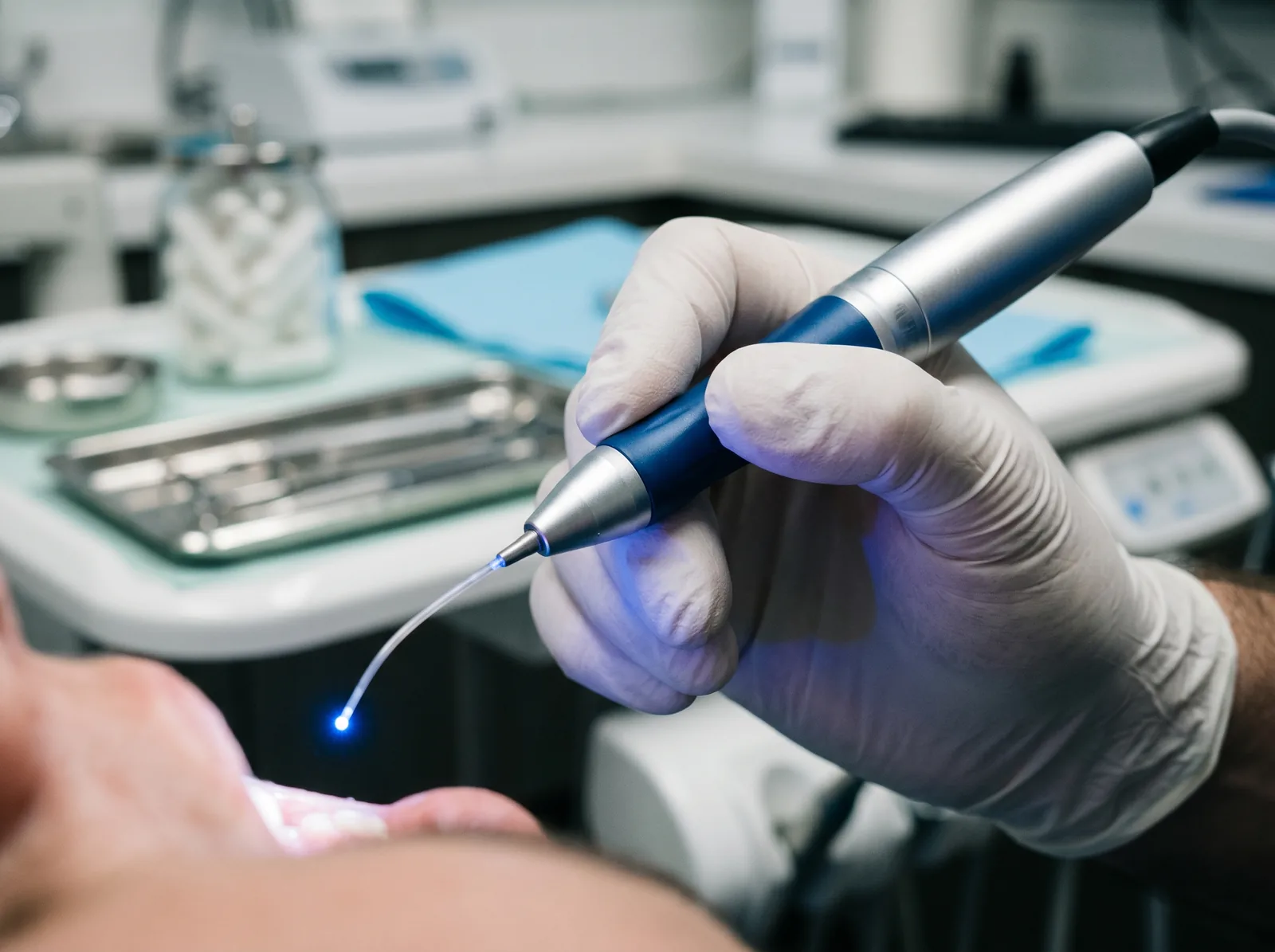
Laser dentistry is incredibly versatile and plays an important role in a growing number of common dental procedures. Though laser dentistry is most notably associated with cosmetic treatments, it is equally effective for preventative purposes.
Here are some of the ways that dental lasers can be used:
- Tooth preparation – Prior to laser dentistry, a drill would be required to prepare the tooth for a filling. Lasers can now completely eliminate the need for drilling and anesthesia. Lasers also successfully kill oral bacteria around the surgical site.
- Reshaping soft tissue – Dental lasers can dissolve soft tissue to expose more of the natural tooth (crown lengthening), reshape soft tissue to make “gummy smiles” more attractive, and remove uncomfortable soft tissue folds caused by denture wear.
- Frenectomy – Lasers can improve speech and the feeding habits of babies, children and adults by untying the tongue.
- Tumor removal – When benign tumors have formed in the soft tissue areas of the mouth, a dental laser can completely remove them without causing pain.
- Whitening – Lasers can greatly expedite the tooth whitening process by increasing the activity of the particles in the peroxide bleaching solution.
- Biopsy – Lasers are sometimes used to perform a biopsy on suspicious areas of soft tissue. This biopsy procedure can be performed instantly and with great precision.
How are laser procedures performed?
Different types of dental laser have been created to treat different conditions. Each laser uses a different wavelength of light, which predicates its best use. The most common types of dental laser are carbon dioxide lasers and diode lasers, which are usually employed to treat soft tissue problems. The dentist will decide which type of laser is best to use after conducting X-rays and a thorough examination.
The laser beam is extremely bright, and special glasses will be provided to protect the eyes. The dentist will then direct the beam at the affected area and carefully dissolve the soft tissue, harden the filling or whiten the teeth.
The procedure will take far less time than conventional methods, and cause far less anxiety and discomfort. The only real disadvantage of laser dentistry is that it can prove to be more expensive.
If you have questions or concerns about laser dentistry, please ask your dentist.
We proudly welcome patients from Old East Village, Argyle, Glen Cairn, Pond Mills, East London, Downtown London, and nearby neighbourhoods. Our goal is to provide trusted, family-friendly dental and wellness care for patients throughout the London community.
- Follow
- Follow
613 Hamilton Road, London, ON, N5Z 1S8
At Fairmont Dental Centre we use a diode soft-tissue laser for a defined set of treatments where a focused beam of light gives us more control than a scalpel or electrosurgery unit. The laser seals small blood vessels as it works, so bleeding is reduced and most patients need fewer sutures. Healing tends to be quieter in the days that follow. The technology supplements traditional dentistry, it does not replace your dentist's clinical judgement, and we only recommend a laser approach when the evidence supports a better outcome for your specific situation.
Common soft-tissue treatments we perform with the laser include:
- Gingival contouring (gum reshaping): evening out an uneven gum line or reducing a gummy smile before veneer or crown work.
- Crown lengthening: exposing more healthy tooth structure when there isn't enough surface area to bond a restoration.
- Frenectomy: releasing a tight upper-lip or tongue frenum that is contributing to a midline gap, speech concerns, or feeding difficulties in infants and older patients.
- Operculectomy: removing the inflamed gum flap that often forms over a partially erupted wisdom tooth.
- Biopsy of soft-tissue lesions: taking a precise sample of an area your dentist wants the pathology lab to review.
- Aphthous (canker) ulcer relief: a brief, low-energy application that can shorten symptom duration.
- Adjunctive periodontal therapy: bacterial reduction inside a pocket alongside scaling and root planing, when indicated.
Candidates, Visit Flow, Aftercare and Cost
Most healthy adults and teens are candidates for laser-assisted soft-tissue work. Children needing a frenectomy are assessed individually, often in coordination with their pediatrician, lactation consultant, or speech-language pathologist. We may recommend a different approach if you take certain medications (for example, anticoagulants that need management), have an active infection at the site, or have an unmanaged systemic condition. Pregnant patients are evaluated case by case, and elective laser cosmetic work is typically deferred.
Here is what a typical laser appointment looks like at our Hamilton Road office:
- Consultation and exam: we review your concerns, take any needed radiographs, photograph the area, and confirm the laser is the right tool for the job.
- Treatment visit: the site is numbed with topical or local anaesthetic. You and the clinical team wear protective wavelength-specific eyewear. Most soft-tissue treatments are completed in 10 to 30 minutes.
- Aftercare: we provide written home-care instructions, a follow-up window, and a direct phone line if you have questions in the first 48 hours.
- Review visit: a brief check at one to two weeks to confirm the tissue is healing as expected.
Aftercare is straightforward. Avoid spicy or acidic foods for the first 24 to 48 hours, rinse gently with warm salt water two to three times a day, brush around (not over) the site for the first few days, and skip strenuous exercise for 24 hours. Most patients manage any tenderness with over-the-counter acetaminophen or ibuprofen as directed; we will tell you if your case needs anything stronger.
Fees vary with the procedure, the number of sites treated, and the time required. For 2026 in Ontario, single-tooth gingival contouring is commonly quoted in the range of $75 to $350 per tooth, multi-tooth aesthetic reshaping in the $1,000 to $3,000 range, and a straightforward frenectomy generally in the $300 to $800 range. We provide a written, itemized estimate with the relevant Ontario Dental Association procedure codes before you commit. Restorative or medically necessary laser procedures (for example, crown lengthening before a crown, or a biopsy) are often partially covered by private dental insurance and the Canadian Dental Care Plan when the indication meets plan criteria. Purely cosmetic gum reshaping is rarely covered. Our team will pre-determine your benefits with your insurer or Sun Life before treatment so there are no billing surprises. Have questions? Call us at (519) 451-4490 or email info@fairmontdental.ca and we will arrange a consultation with Dr. Edward Pham or Dr. Alain David.